New Seminars in Hearing: Workforce Sustainability in Audiology: Evidence, Challenges, and a Roadmap to Autonomy
 Features Guest editors: Victor Bray, Ph.D., and Amyn M. Amlani, Ph.D.
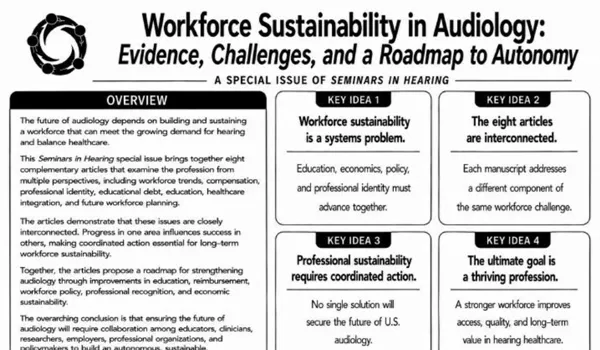
Nearly two decades after the Au.D. became the entry-level degree, is audiology training enough audiologists, paying them fairly and giving them the authority to practice as an autonomous doctoral profession? The new issue of Seminars in Hearing answers with data. Its preface and eight articles show how audiologists’ supply, education, wages, student debt, legal classification and reimbursement together determine the success of the profession. The issue closes with a phased roadmap built on ADA's Audiology 2050 framework.
Audiology 2050: from vision to roadmap
The Seminars in Hearing issue uses Audiology 2050, first articulated by ADA, as its organizing framework. The closing article describes it as "shared infrastructure" for the whole profession, not one organization's initiative. Forty-one experts (a 79% response rate) from eight segments of the profession commented on all seven Audiology 2050 domains:
- Scope of practice consistent with other clinical doctors
- Standardized, evidence-based practice
- A professional workforce, including extenders
- Professional socialization
- Audiologists as advocates and activists for the profession
- Medicare limited license practitioner (LLP) status
- Primary care entry point for auditory and vestibular conditions
A key finding from the final article is that order of execution matters. The Audiology 2050 domains depend on one another, and the authors suggest timelines for focus in each area. The authors also spell out the cost of inaction, calling for internal culture change and noting that the profession of audiology has to fully take on the doctoral-level identity and responsibility it's asking the health care system to recognize.